
Trianon Custom Parquet Flooring
Custom parquet flooring is wood assembled into a pattern rather than laid as a run of boards. The Trianon panel is the one clients ask for most often: a square field of interwoven staves held inside a mitred frame, repeated across a room so the floor reads as a series of framed panels rather than as a continuous surface. VOGUE Parquet® makes it, and everything like it, to order in French and European oak.
This page covers what a panel is, how a bespoke pattern is developed, and what has to be settled before one is made. It sits under our parquet flooring collection.
The Parquet Panel Collection


Panel, Frame and Field
What a Custom Parquet Flooring Panel Is
A custom parquet flooring panel is a piece of joinery rather than a floorboard. Short lengths of oak are cut, machined and assembled into a repeating figure, and that figure is held square by a frame of straight staves mitred at the corners. The whole assembly is built on a stable engineered backing so that the panel behaves as one piece when the humidity in a room changes.
Panels are made to a set size, typically somewhere between two and four feet square, and laid edge to edge so the frames form a continuous grid across the floor. Because each panel is complete in itself, the pattern arrives on site already resolved, and the installer is setting out squares rather than assembling a design.
That is the practical advantage of custom parquet flooring over an equivalent pattern cut piece by piece on site. The precision happens in a workshop with the right machinery, under controlled humidity, and what reaches the building is checked and repeatable.
Trianon is a lighter, more open figure of custom parquet flooring than the Versailles panel it is usually compared with. Where Versailles fills its frame with a dense woven lattice, Trianon leaves more of the field visible and reads as a quieter, more geometric pattern from standing height. In a room with a lot of furniture that restraint is an advantage.
Its proportions also make it more forgiving in a contemporary interior. The frame is narrower relative to the field, the internal figure has fewer parts, and the whole panel sits comfortably in a room without traditional cornices or panelling to answer it. It is the panel we specify most often in modern apartments where the client wants pattern without period.
Both patterns are available in the same oak, grades and colours as our plank, which means a Trianon floor in a formal room can meet a plank floor elsewhere in the apartment with no change of material and no change of tone.
Beyond the Named Patterns
The named historic panels are a starting point rather than a catalogue. The documented history of parquetry is a useful reference whenever a historic figure is being reproduced. Custom parquet flooring means the pattern can be drawn for the project, and that is most of what we do at this end of the range. A figure can be simplified for a modern room, scaled up for a large hall, or set out so a particular line lands on a particular architectural feature.
Materials can be mixed within a panel. A field in one colour with a frame in another, a border in a darker tone, or an inlay of a contrasting species will all read as deliberate provided the whole thing is designed rather than assembled from what is available.
Scale is the first thing to settle in a drawn pattern. A figure that reads well at two feet square can become restless at four, and a large room does not automatically want a large panel; often it wants the same panel repeated more times, so the grid stays legible from the door. We work this out on the plan before any timber is cut.
Purely geometric work sits here too. Squares, diamonds, basketweave and modular grids are all made the same way and give a room order without any period reference at all. Our note on chevron parquet panels covers one version of that approach.
The process runs in four stages and it is worth understanding before a programme is set. It begins with a drawing, usually ours worked up from the architect’s floor plan, that establishes the panel size, the figure, the frame width and how the grid lands against the walls and openings of the actual room.
The second stage is a sample panel. One panel is made in the specified oak, grade, colour and finish, and it is signed off before anything else is cut. Nobody should approve custom parquet flooring from a rendering, because the interaction between the figure and the grain is the whole point of the material and it cannot be drawn.
The third stage is production, with the whole floor made from one selection of timber and one stain batch. The fourth is a set-out drawing issued to the installer showing exactly where the first panel goes and how the perimeter is resolved, so the decisions made at the drawing stage survive contact with the site.
A FLOOR DRAWN FOR THE ROOM IT WILL SIT IN

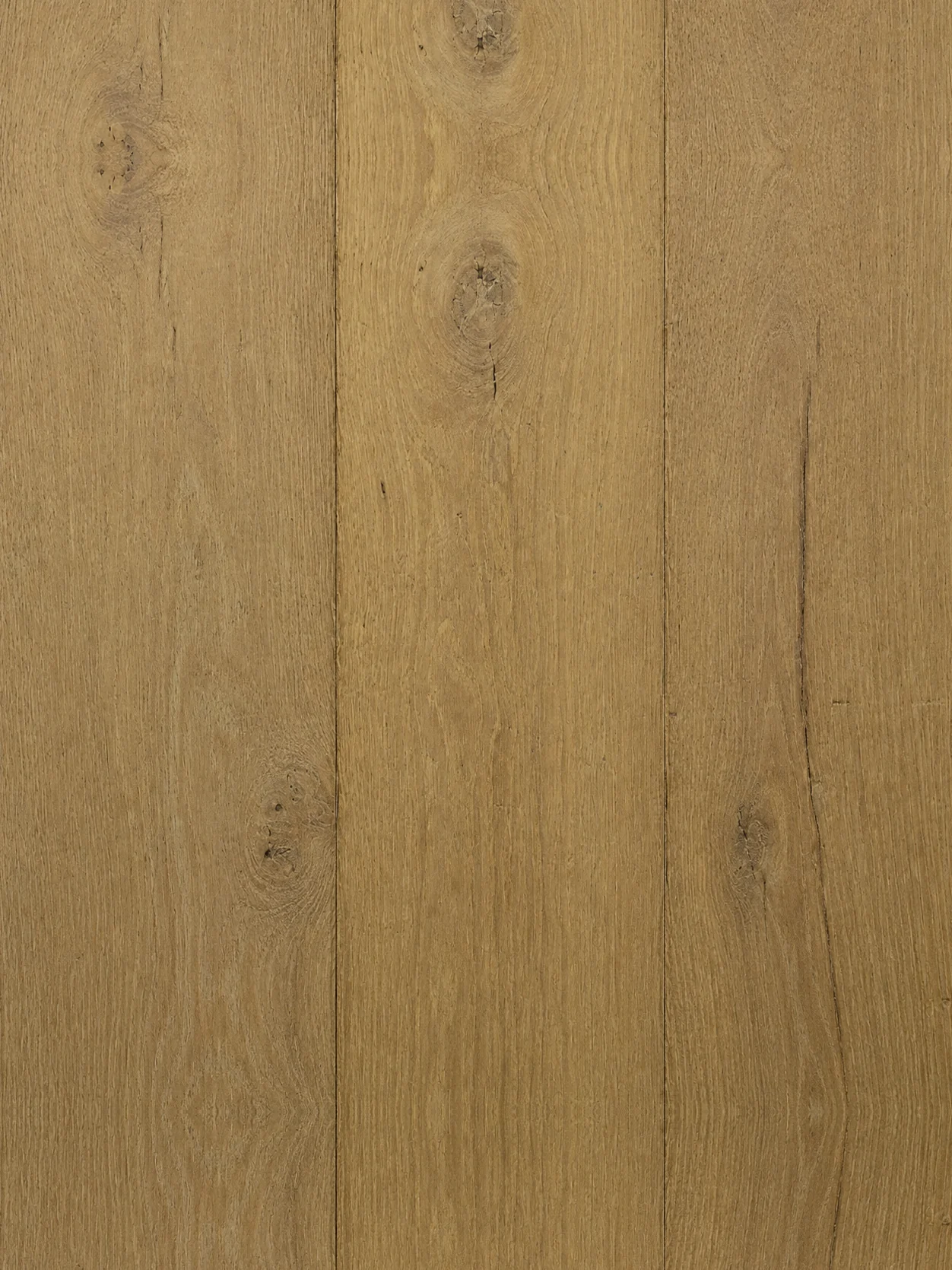
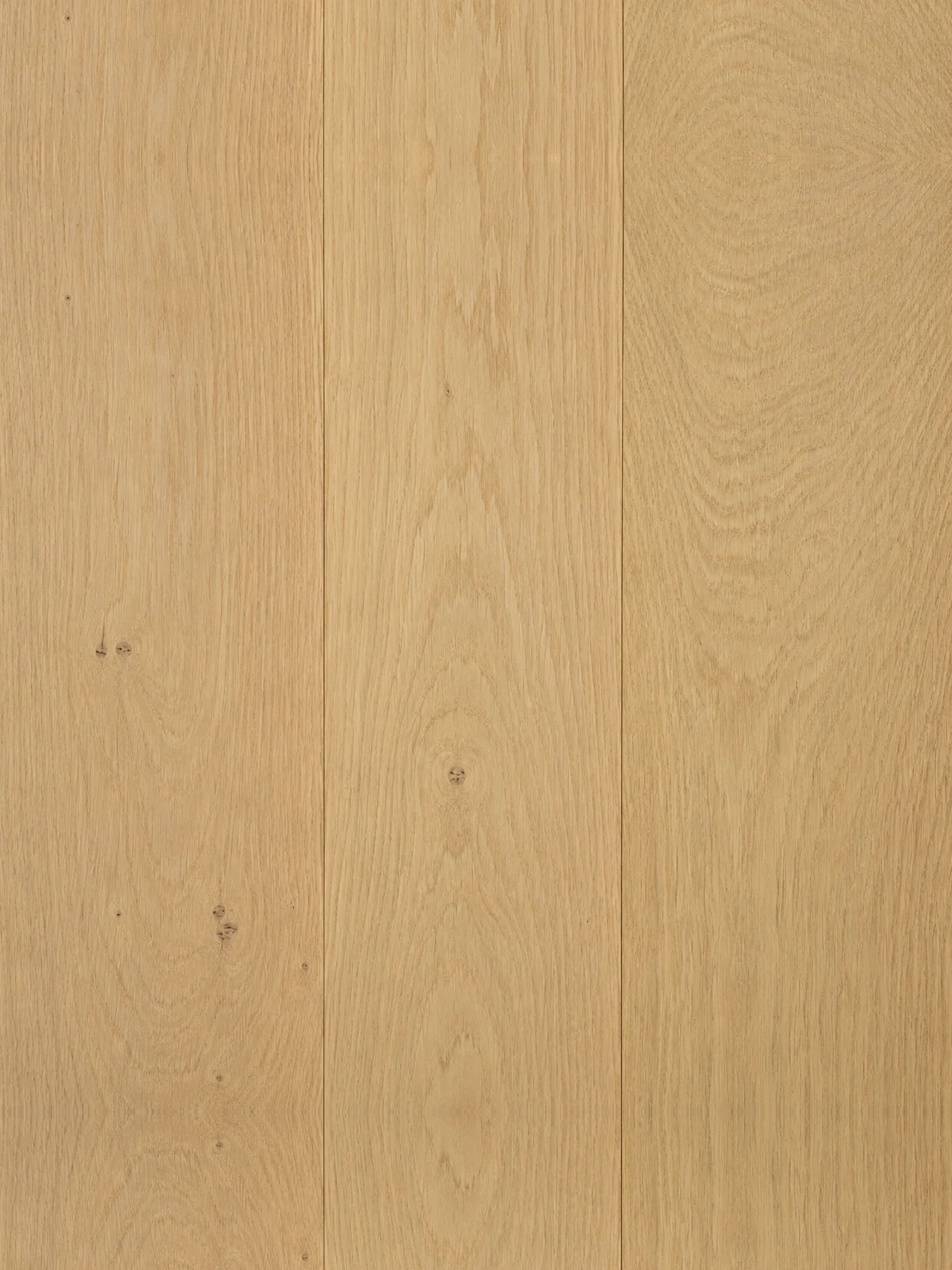


Trianon, Versailles, or a figure drawn for the project and cut to a set-out drawing.
Oak, Grade and Colour in Custom Parquet Flooring
Custom parquet flooring panels are cut from the same French and European oak as the rest of our range. Select grade is the usual choice, because a panel is a piece of geometry and heavy figure competes with it, but light rustic is right where the intention is a floor that looks as though it predates the building.
Colour behaves in a particular way on custom parquet flooring. The staves within a panel run in several directions at once, so light strikes them differently and a single colour produces a range of apparent tones across the figure. That is what gives a good panel its depth, and it is why panels look flat in photographs and never in a room.
The full colour range is available, from bleached and pale greys through honey and sand to chestnut and near black. All of it is developed with reactive stains that work with the tannin in the oak. The range is shown in our European oak flooring collection.
Custom parquet flooring works best in rooms with a centre and a boundary. Formal dining rooms, libraries, entrance halls, drawing rooms and private studies all have a middle that the grid can be set out from, and walls close enough to read the frame against.
They work less well in large open-plan floors with no defined edges, where the grid runs off into the distance and loses its logic. In that situation a running pattern such as French oak herringbone flooring or French oak chevron flooring is the better answer.
The most successful projects use custom parquet flooring selectively. One or two rooms take the panel, the rest of the floor stays plank in the same oak and colour, and the hierarchy that creates is worth more than covering the whole apartment in pattern.


CUSTOM PARQUET FLOORING
Made to order
PANELS ASSEMBLED BY HAND, AS THEY HAVE BEEN FOR THREE CENTURIES
Frames, Borders and Thresholds
Because custom parquet flooring is laid as a grid, the perimeter almost never works out to a whole panel, and the way that is resolved is what separates a considered floor from an awkward one. A border of plain boards around the room absorbs the difference and gives the grid a clean edge, and it should be wide enough to look intentional rather than like a filler strip.
A double border, with a fillet of a contrasting colour between two plain runs, turns the edge into part of the design. This is the traditional treatment and it suits rooms with joinery or panelling that it can answer.
Thresholds want the same care. Where custom parquet flooring meets plank at a doorway the join should fall under the door leaf, and where it meets stone the setting out should be adjusted so that a full panel, not a cut fragment, sits at the junction.
Custom parquet flooring is fully bonded to the subfloor, never floated. A panel that is not held down will move at its edges and the grid will open at the joints, which is the one fault that cannot be disguised in a panelled floor.
Flatness tolerance is tighter than for plank, because a panel is rigid and will bridge a hollow rather than follow it. The subfloor has to be levelled, cured and tested before delivery, and moisture content measured and recorded rather than assumed.
Installation is slower than plank and slower than a running pattern, because each panel is placed against a set-out line and checked. On the other hand there is no finishing work on site: panels arrive prefinished, so there is no sanding, sealing or curing time in the programme.
Maintaining and Repairing a Panelled Floor
A panelled floor is easier to live with than its appearance suggests. The finish is the same matt urethane or natural oil we use on plank, so the routine is the same: a soft brush, an occasional damp mop, matting at the doors and felt under furniture. Grit is what damages a wood floor, not water.
Repair is where custom parquet flooring has a real advantage over a long-board floor. Damage is contained within one panel, and a single panel can be lifted and replaced without disturbing the grid around it, which is why we hold a small reserve of panels from the original batch on every project we supply.
Refinishing follows the same logic as our plank. The wear layer is solid oak at four millimetres, which carries two or three full sandings, so a panelled floor can be brought back rather than replaced. Given the cost of the material that reserve is a significant part of what is being bought.
Custom parquet flooring is the longest lead item we supply, typically twelve to sixteen weeks from approved sample to delivery, and longer where a pattern is being drawn from scratch. The sample panel stage alone takes several weeks and cannot usefully be compressed, because it is the stage that prevents an expensive mistake.
Quantities are calculated in panels rather than in area, with an allowance for the perimeter cutting and the border. The allowance is smaller than for a running pattern because the panels themselves are made to size, but the border material has to be ordered from the same batch at the same time.
A shortfall is more serious here than in any other product. There is no shelf to draw from, so a top-up means a new production run, a new stain batch and a wait measured in months.
What Drives the Cost
Three things move the price of custom parquet flooring. The first is the number of parts in the figure, because every additional piece is another cut, another joint and another chance to be out of tolerance. A simple geometric panel costs a fraction of an intricate historic one.
The second is whether the pattern already exists. A Trianon or Versailles panel is made to established tooling and settings; a pattern drawn for one project carries the design work and the first-article sample with it.
The third is size. Larger panels use longer, wider and therefore rarer boards, and they are harder to keep flat, so the price does not rise in a straight line with the area. None of this affects the wear layer or the working life, which are the same as our plank.
Request Parquet Samples
No drawing shows how the figure and the grain work against one another, and no rendering shows what a panel does to the light in a room, so custom parquet flooring is always approved from real material rather than from an image. Begin with the colour. Our Bottega collection holds the full oak palette, and samples are sent anywhere in the United States. Once the colour is settled we make a single panel in the specified oak, grade and finish, and that panel is signed off before anything else is cut.