French Oak Flooring
French oak flooring is the material most often chosen when an interior has to look considered rather than decorated. It is cut from oak grown in managed French forests, milled in France, and finished to order rather than pulled from a warehouse. VOGUE Parquet® supplies French oak flooring as an engineered board with a solid oak wear layer, in wide plank, herringbone, chevron and custom parquetry, in select and light rustic grades.
This page sets out what the material is, how it is built, and what has to be decided before a floor is ordered. It sits above our city pages and our pattern collections, so if you already know the format you want you can move straight to it from the links below.
The French Oak Collection


Grain, Grade and Origin
What Sets French Oak Flooring Apart
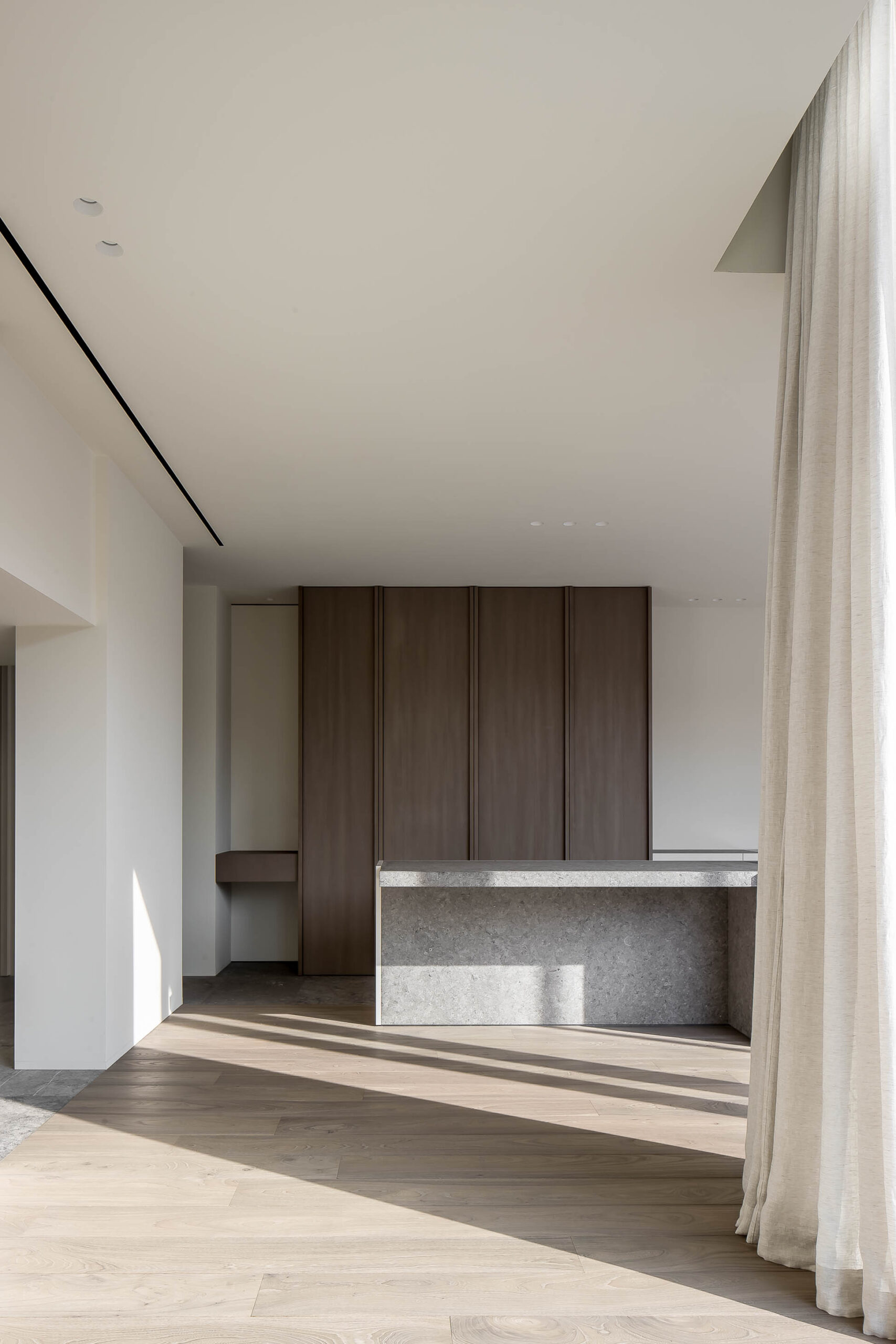
Oak grows slowly in the French climate, and slow growth produces tight, even grain with narrow rings and very little of the coarse figure found in faster-grown timber. The two species involved, Quercus robur and its close relative Quercus petraea, are the same oaks used across European joinery. That is the practical reason French oak flooring has held its position with architects for so long. The grain accepts a stain evenly, so a whole floor reads as one material rather than as a set of boards that happen to sit beside each other.
The second reason French oak flooring reads differently is milling culture. French mills cut for appearance first, which means more of the log is rejected and the boards that survive are more consistent in colour and character. You notice this most on a large floor, where inconsistency compounds. Across a fifteen-hundred square foot apartment the difference between careful and careless selection is the difference between a floor that recedes and one that keeps drawing the eye to a bad board.
There is also the question of what the timber does over time. French oak flooring darkens gently and unevenly in the best sense, taking on depth around traffic routes and under light, rather than bleaching or yellowing. It is a material that improves with age, which is the argument for spending on it in the first place.
Every French oak flooring board we supply is engineered. The wear layer is solid French oak, four millimetres thick, bonded to a dimensionally stable core with the grain running across that of the surface. The cross-grain construction is what stops the board cupping or gapping when the humidity in a room swings, which is why engineered construction is now standard in serious residential work rather than a compromise.
Four millimetres matters. It is enough to sand and refinish the floor two or three times over its life, which takes a French oak floor well past the point where most interiors are renovated anyway. Thinner wear layers exist and cost less, but they turn the floor into a finish rather than a material, and they cannot be brought back after damage.
Boards are tongued and grooved on all four edges and supplied prefinished, so there is no sanding, no sealing and no curing time on site. For occupied buildings and phased projects that is often the deciding factor.
French Oak Flooring Grades and What They Mean in a Room
We supply French oak flooring in two grades. Select is the calmer of the two, with even colour, minimal sapwood and only small, sound knots. It suits interiors where the floor is meant to be a quiet ground for furniture, art and stone, and it is the usual choice for apartments and for rooms with a lot of glass, where any strong figure would compete with the view.
Light rustic carries more movement. Knots are larger and more frequent, colour varies more from board to board, and there is more of the mineral streaking that reads as age. It suits houses rather than apartments, and rooms with height and beams and stone, where a floor with no character at all would look thin.
Neither grade is a quality ranking. Both are cut from the same timber to the same tolerances, and both carry the same wear layer. The choice is an aesthetic one, and it is easier to make with samples on the actual floor in the actual light than from a photograph. Our note on hardwood flooring grades goes through the distinction in more detail.
French oak flooring plank widths run at seven and a half and eight and a half inches, with lengths up to around eight feet. Wide boards change a room in a way that is hard to appreciate until you see it. Fewer joints means fewer lines interrupting the floor, and the eye reads the surface as a plane rather than as a series of strips, which makes a room feel broader and calmer.
Wide French oak flooring is also more demanding of the timber. A wide board shows any defect at full size and moves more across its width, so it can only be cut from good logs and has to be built and dried properly. That is precisely why it is a mark of quality rather than a style choice.
Length matters as much as width and is often overlooked. Short boards create a busy, repetitive pattern of end joints that undermines the effect of the width. We supply long-length material as standard because a wide plank in short lengths is a compromise.
OAK THAT HAS TAKEN A CENTURY TO GROW AND WILL TAKE ANOTHER TO AGE



Made to order in France, milled to the width you specify and delivered finished.
Patterns Cut From the Same Oak
The same timber and the same finishes are available in pattern as well as in plank, which is what allows a single project to move between the two without a change of material. A hall or a formal room can take a pattern while the rest of the floor stays plank, and because both come from the same mill run the colour matches.
Herringbone is the more forgiving of the two patterns, cut square at both ends and laid at a right angle, and it works in rooms of almost any proportion. Our French oak herringbone flooring is supplied in a five and a half inch size in both grades.
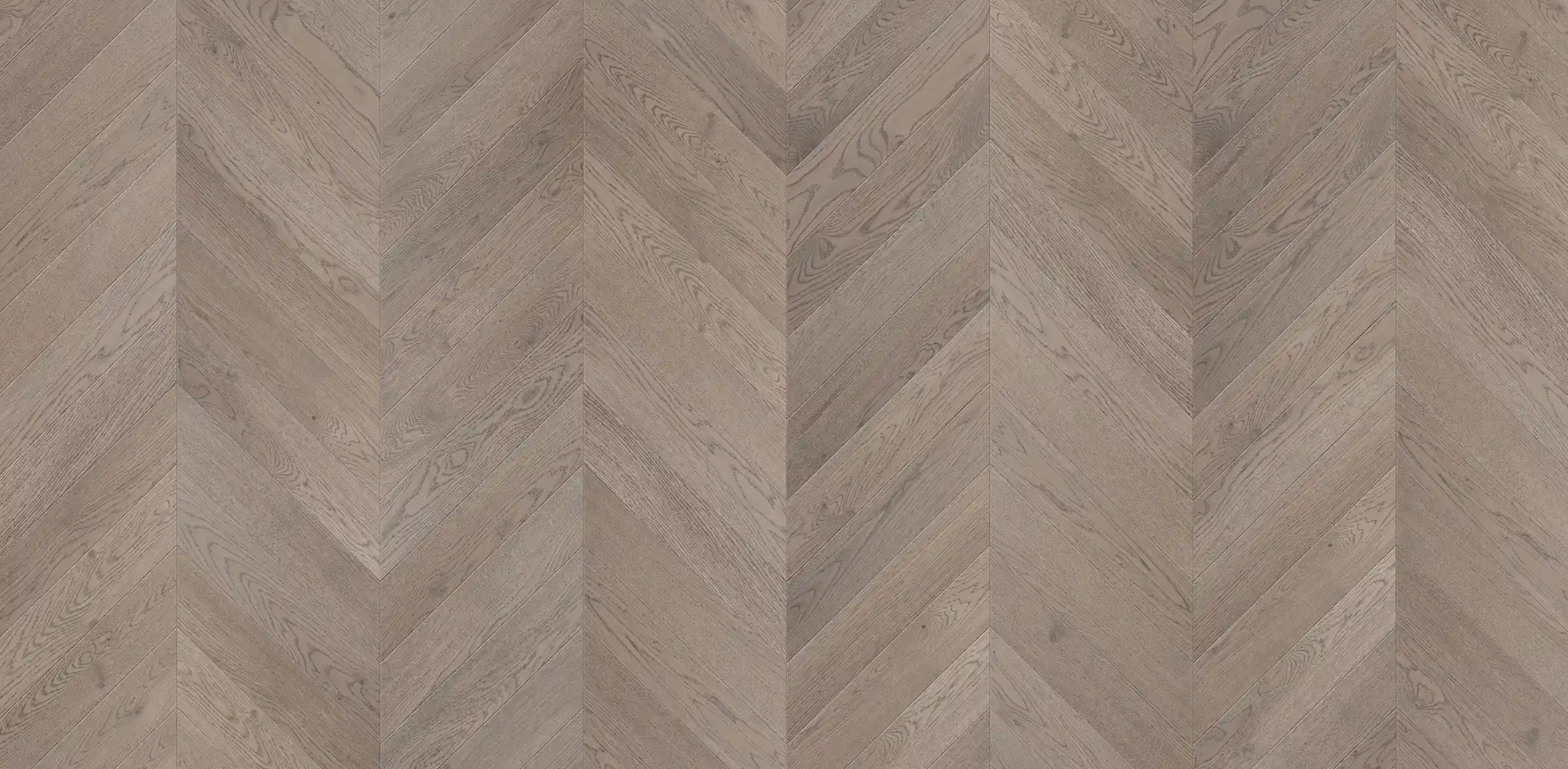
Chevron is cut on a mitre so the boards meet point to point in a continuous V. It is more exacting to make and to lay, and it produces a strong directional line that suits long rooms and entrances. Our French oak chevron flooring is available in two sizes and in both grades.
Beyond the two running patterns there is the panel work, where French oak is cut and assembled into custom parquet flooring such as Trianon and Versailles. Those are made to order to a drawing.


FRENCH OAK FLOORING
Select and light rustic
MILLED IN FRANCE, FINISHED TO ORDER, LAID ONCE
Colour, Reactive Stain and Finish
Colour on French oak flooring is not paint. The oak is treated with reactive stains that respond to the tannin in the timber itself, so the colour develops out of the wood rather than sitting on top of it. Two boards from different parts of the same log will take the same stain slightly differently, and that variation is what stops a coloured oak floor looking like a laminate.
The range runs from very pale, almost bleached tones through the warm middle greys and honeys to deep chestnut and near black. Pale colours open a room and are forgiving of dust; darker colours give weight and show more, and are usually specified where the floor is meant to anchor a scheme rather than disappear into it.
French oak flooring is finished in either matt urethane or natural oil. Urethane is the harder-wearing of the two and needs almost nothing beyond sweeping and an occasional damp mop. Oil gives a closer, drier feel underfoot and can be spot-repaired without refinishing a whole floor, at the cost of periodic re-oiling. If the difference in appearance matters to you, our note on matte and gloss wood flooring covers it.
French oak flooring is compatible with radiant heat, which is why it is specified as readily in cold climates as in warm ones. The engineered core is stable enough to sit over a heated slab without the movement that would make a solid board unusable, provided the system is commissioned properly and the floor temperature is brought up slowly.
Humidity is the variable that actually matters. Oak is happiest between roughly forty and sixty percent relative humidity, and a house that swings well outside that range for months at a time will move any wood floor. In practice this means humidification in very dry winters and dehumidification in very wet summers, both of which most luxury homes already have.
Maintenance of French oak flooring is undemanding. Grit is the enemy rather than water, so mats at entrances and felt under furniture do more for a floor than any product. Our guide to hardwood floor cleaning sets out the routine.
Where the Material Belongs
Most of what we supply goes into private residences, and the pattern of use is consistent. Plank runs through the main living floors, a pattern lifts an entrance hall or a formal dining room, and the same colour carries into bedrooms so the whole apartment or house reads as one surface. That continuity is easier to achieve with a made-to-order material than with anything bought off a pallet.
The second category is the tower apartment, where a design review board and a building specification often govern what can be laid. Engineered French oak flooring passes most of those requirements comfortably because it is thin, stable and can sit over an acoustic underlay without losing the finished floor height.
The third is the development, where several units have to match each other and match the show apartment a year later. That is a supply problem rather than a design one, and it is solved by reserving material from a single mill run at the outset. The same logic applies across our parquet flooring and herringbone flooring collections.
Specifying French Oak Flooring for a Project
The specification a contractor can actually price needs six things: grade, width, pattern, colour, finish and quantity including waste. Everything else follows from those. We issue a written specification for each project so that the material quoted is the material delivered, which removes the most common source of dispute on a flooring package.
Quantity is where projects most often go wrong. Plank needs around seven percent over the measured area, herringbone around ten, and chevron closer to fifteen because of the mitred ends. Ordering short and topping up later means a second mill run and a colour that may not match, so the allowance is not padding.
Subfloor is the other thing to settle early. Moisture content has to be measured and recorded before delivery, not on the day of installation, and any levelling has to be finished and cured. Most delays we see on French oak flooring projects are subfloor delays wearing a different name.
Because French oak flooring is made to order rather than stocked, colour, width and pattern can be varied for a project. That includes matching an existing floor, developing a stain to sit with a particular stone or joinery, and cutting a panel pattern to a drawing. For larger residences and for developments where several units have to look identical, material is reserved from a single run so the whole project draws from one batch.
Lead times run from six to twelve weeks depending on the format and the finish, with custom parquetry at the longer end. This is the part of the process that most often surprises people coming from a stock product, and it is worth building into the programme early. Once the material is on site, installation of a French oak flooring package moves quickly because there is no finishing work.
Request French Oak Samples
French oak is chosen from the board rather than from a photograph. Grain, grade and the depth of a reactive stain only resolve when the piece is in your hand and the light of your own room is falling across it. Every colour we make can be sent to you, cut from current production and recorded with its grade, wear layer and finish, so a specification can be written from the material itself. Requesting them takes a moment. Open the Bottega collection, choose the colours you want to see, and they are sent anywhere in the United States.
Where French oak sits against the American species, in grain, grade and origin, is set out in our comparison of French oak against American oak. The milling and hand finishing behind every board is described in the atelier behind the floors.