Wide Plank Flooring
Wide plank flooring is the format specified when a room is meant to read as architecture rather than as decoration. VOGUE Parquet® supplies it in European oak, milled to order in widths drawn for the run of the room rather than the convenience of the mill, and graded, finished and documented for the project it is going into. Nothing here is taken from a stock range. Every wide plank flooring order is milled for one project.
The Wide Plank Collection


Width, Grade and Construction
What Sets Wide Plank Flooring Apart
There is no single figure at which a board becomes wide, and any supplier who gives you one is selling a stock item. What matters is the relationship between the board and the space. A room of modest proportion is overwhelmed by a very broad board, while a long open volume makes a narrow board look busy and restless from the far end. Width is chosen after the plan is understood, not before it. That is the first decision in any wide plank flooring specification.
In practice most of what we supply sits between seven and twelve inches, with wider boards drawn for rooms where the architecture can carry them. Length matters as much as width and is discussed far less. A wide board in short lengths still reads as a patchwork, and the calm clients associate with this format comes from long boards running uninterrupted through a space. Length distribution is written into every wide plank flooring order for that reason.
A wide board is a demanding thing to make. The wider the plank, the more the timber has to be trusted to stay flat, and the less forgiving the grade becomes because every board shows more of itself. European oak, the group that takes in Quercus robur and Quercus petraea, suits the format because slow growth in a temperate climate produces tight, even rings and a grain that stays calm across a broad face. It is the species behind the wide plank flooring we supply in every market.
Construction does the rest. A sawn oak wear layer over a dimensionally stable core holds its line across the seasonal movement a solid board of the same width would take in its edges. That is why engineered construction is the standard specification for a broad board in almost every climate we supply, and it is a question of physics rather than of cost. Engineered wide plank flooring is the standard here for that reason alone.
Wide Plank Flooring Grades and What They Mean in a Room
Grade is the decision that changes a wide floor most, and the one clients find hardest to judge from a small sample. A select grade reads as a drawn line, calm and consistent, with very little incident across the surface. It suits interiors where the architecture, the art or the view is the subject and the floor is there to hold everything together quietly. Grade is fixed before any wide plank flooring is milled.
A character grade carries knots, sapwood and mineral streak, and gives a room warmth that a very controlled scheme can otherwise lack. On a broad board that character has room to be seen, which is exactly why some clients choose it and others avoid it. Neither is better. The mistake is choosing from a piece too small to show how often the incident repeats.
Engineered construction is the default, but solid oak has not disappeared and there are projects where it remains right. A stable interior climate, a timber deck rather than a slab, no underfloor heating, and a client who wants the floor sanded by a grandchild rather than replaced: in those conditions a solid wide board performs for generations.
What solid will not tolerate is a climate that swings, a slab with moisture in it, or heating beneath it. In those conditions a solid board of any real width will cup in one season and gap in the next, and no installation method compensates. The construction is chosen from the building, never from preference. That applies to wide plank flooring in every climate we ship to.
Where a project genuinely needs the depth of a solid board but sits in a difficult climate, a thick sawn wear layer over a stable core gives most of what solid offers with none of the risk. The surface is real timber of substantial depth, it can be sanded several times across its life, and it stays flat.
A BOARD WIDE ENOUGH TO READ AS ARCHITECTURE


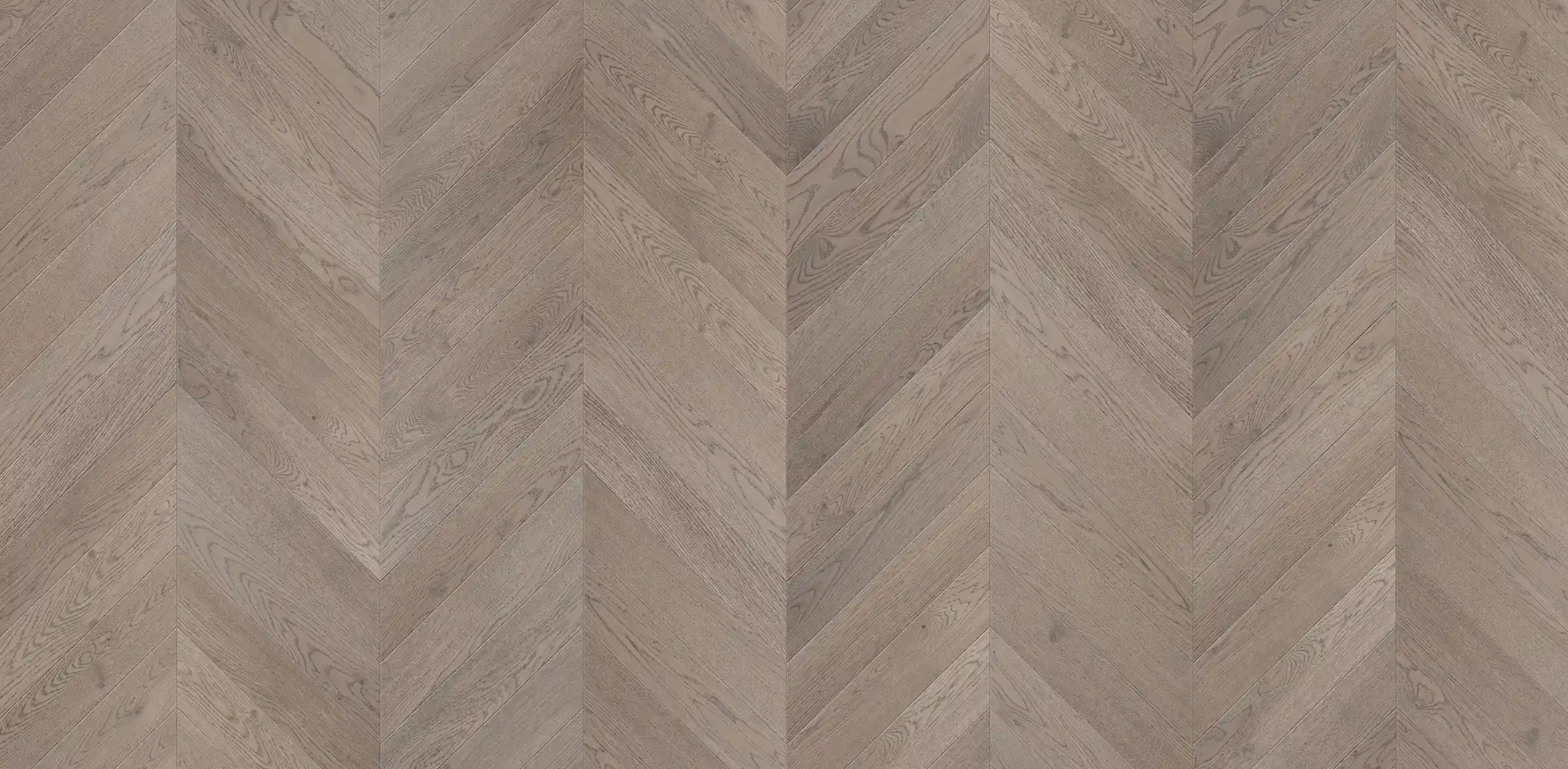

Milled to order in European oak, in the width the room asks for.
Patterns Cut From the Same Oak
A plank floor and a pattern floor answer different problems. A broad board steps back and lets the room speak, which is why it dominates contemporary residential architecture. A pattern brings scale and incident to a space that has a great deal of floor and very little happening on it.
Many projects use both, and the transition between them is where a specification earns its fee. A herringbone floor in an entrance hall opening onto a plank floor through the living spaces is a common and successful arrangement, as is a chevron panel in a formal room. Our guide to wide plank and herringbone sets out where each belongs. Wide plank flooring and pattern are specified together more often than apart.
A wide plank floor also sounds different from a narrow one, and clients notice it before they can describe it. A broad board bridging a joist or a slight hollow in a slab produces a drummy note underfoot, and once it is heard it cannot be unheard. The cure is in the substrate and the adhesive rather than in the timber.
A fully bonded installation over a flat, sound deck gives the quietest and most solid result. A floating floor over an acoustic mat will always have a little more movement and a little more sound, which is the trade for the impact performance it delivers to the space below. Where a building requires the mat, the flatness of the deck matters even more, because the mat will not correct a hollow.


WIDE PLANK FLOORING
Wide plank and pattern
MILLED TO ORDER, FINISHED TO THE PROJECT, LAID ONCE
Colour, Reactive Stain and Finish
Oak carries tannin, and tannin is what makes it so responsive to finish. A reactive treatment changes the timber itself rather than coating it, drawing out grey, olive and umber tones that come from the wood. Fumed and smoked finishes carry colour through the thickness of the board, so wear does not expose a pale line beneath the surface.
A surface colour applied over oak behaves differently. It shifts under sustained daylight and it shifts unevenly wherever furniture and rugs shade part of the floor. On a broad board those differences are more visible because there are fewer joints to interrupt them. For a floor meant to last decades, the colour should be in the material. That is the finish standard we hold for wide plank flooring.
The edge detail decides how a wide floor reads underfoot and in raking light. A square edge gives the most continuous surface, with the boards reading as one plane, and it asks the most of the subfloor and the installer. A fine micro-bevel defines each board, forgives a little more, and suits a floor with visible character in the grade.
Ends deserve the same attention and rarely get it. A floor with too many short boards shows its joints as a rhythm across the room, which undoes the calm the format was chosen for. We specify a length distribution rather than an average, so the long boards land where they will be seen. It is the least visible part of a wide plank flooring specification and one of the most important.
Where Wide Plank Flooring Is Specified
A broad board is less tolerant of a poor subfloor than a narrow one, because any deviation in the slab telegraphs through a wide face. Flatness tolerance should be agreed in writing before delivery, not discovered on the morning of installation, and moisture readings should be taken on site rather than assumed from a schedule. No wide plank flooring is delivered before those readings exist.
Build-up height is the other common surprise. Finished floor level is usually fixed by door heights, thresholds and adjoining materials, and a wide plank specification with an acoustic layer beneath it can be thicker than the allowance left for it. We establish total assembly height early, because a specification is far cheaper to change on paper than a door frame on site. Wide plank flooring assemblies are thicker than clients expect.
We prepare sample panels in the width, grade and finish proposed rather than a catalogue chip, and we dry-lay them in the room so the material can be judged in its own light. Width, length distribution, grade, finish and edge detail are then fixed on a specification sheet the contractor builds from and the client signs.
Batch records are held against the project. A residence built over two seasons, or a development delivered floor by floor, can be matched exactly on a later order, which is worth more over the life of a building than any single delivery. Every wide plank flooring order is recorded against the project for that reason.
What the Floor Asks For Once It Is Down
Wide plank flooring is specified nationally, and the conditions change with the market. Our city pages set out what differs: Miami for coastal humidity and indoor to outdoor thresholds, New York for pre-war buildings, board approvals and floor build-up, and Los Angeles for hillside houses, glass walls and dry heat.
The species itself is covered under French oak flooring, and the full range of colours and finishes can be seen in the Bottega collection. For a closer account of the material behind the format, read wide plank European oak flooring.
Underfloor heating and a broad oak board live together constantly, but only where the specification acknowledges it. The wear layer, the core, the adhesive and the commissioning schedule all have to be chosen for a floor that will be warmed and cooled deliberately, and surface temperature limits should be written in and observed during commissioning.
The failures we are asked to inspect almost always trace to the same thing: a system brought up to temperature too quickly after installation, or a screed that had not finished drying when the boards went down. Neither is a fault in the timber, and both are avoidable with a commissioning programme agreed before delivery.
Request Wide Plank Samples
Wide plank flooring is a long commitment in a building, so the questions that protect a client are the practical ones rather than the decorative ones. Ask what the wear layer actually measures rather than the total board thickness. Ask whether length distribution is specified or averaged. Ask whether the finish can be repaired in place or only sanded. Ask whether the batch can be matched on a later phase, and ask to see that in writing.
Those four answers separate a specified floor from a stocked one, and they are the questions the architects and designers we work with ask first. They matter more on wide plank flooring than on any narrow board. Colour and width are then settled in the room itself, on panels large enough to judge, rather than from a photograph.