European Oak Herringbone Flooring
European oak herringbone flooring is the specification most often reached for when a project needs the pattern at scale. It draws on oak grown across the continent rather than from a single region, which widens the colour range, steadies the supply and makes it possible to hold enough material from one run to floor a whole building. VOGUE Parquet® supplies it engineered, prefinished and made to order, in select and light rustic grades.
This page is about the material and the supply rather than the geometry. If you want the setting out, the borders and the layout options, those are covered on our herringbone flooring and French oak herringbone flooring pages.
The European Oak Herringbone Collection



Origin, Grade and Supply
What European Oak Actually Means
European oak is a species description, not a country of origin. It covers the two oaks that grow across the continent, from the Atlantic coast through central Europe and into the Balkans, and the timber trade uses the term for oak from any of those forests. It is a broader label than French oak, which names one origin within it.
The breadth is the point. Different forests give slightly different colour and grain, and a supplier working across several of them can select for a particular look and hold that selection over time. Oak from cooler, higher ground grows more slowly and comes out tighter and paler; oak from warmer, lower forests grows faster and carries more colour.
What matters for a floor is that European oak of any origin shares the same working properties. It takes a reactive stain the same way, it moves the same amount with humidity, and it machines to the same tolerances, which is why European oak herringbone flooring behaves predictably regardless of which forest the batch came from.
The honest comparison is one of selection rather than quality. French mills grade hard for appearance, so a French oak floor arrives with less variation and costs more for that reason. Oak from elsewhere in Europe carries a little more range from piece to piece, and on a running pattern that range is visible.
For most projects the difference is not a problem, and in light rustic it is not even a disadvantage, because variation is what the grade is for. Where it matters is a large select floor under strong daylight, and that is the case where the extra cost of French oak buys something you can actually see.
The other real difference is availability. European oak herringbone flooring can be supplied in the volumes a development needs, in one colour, from one run, with a repeat order possible months later. French oak in the same quantity is harder to reserve and slower to repeat. Our French oak flooring collection sets out the alternative in full.
Colour in European Oak Herringbone Flooring
Every colour we produce in plank can be cut as European oak herringbone flooring, and the range is deliberately wide because the pattern changes how a colour reads. The pale end runs from a bleached, almost white oak through soft greys and sand tones. The middle holds the honeys and the warm neutrals that sit well with brass, stone and pale joinery. The dark end runs through chestnut and tobacco to a near black.
Colour on oak is developed with reactive stains that respond to the tannin in the timber rather than with a pigment sitting on the surface. That is what gives a coloured oak floor its depth, and it is also why two pieces from different parts of the same log take the stain slightly differently.
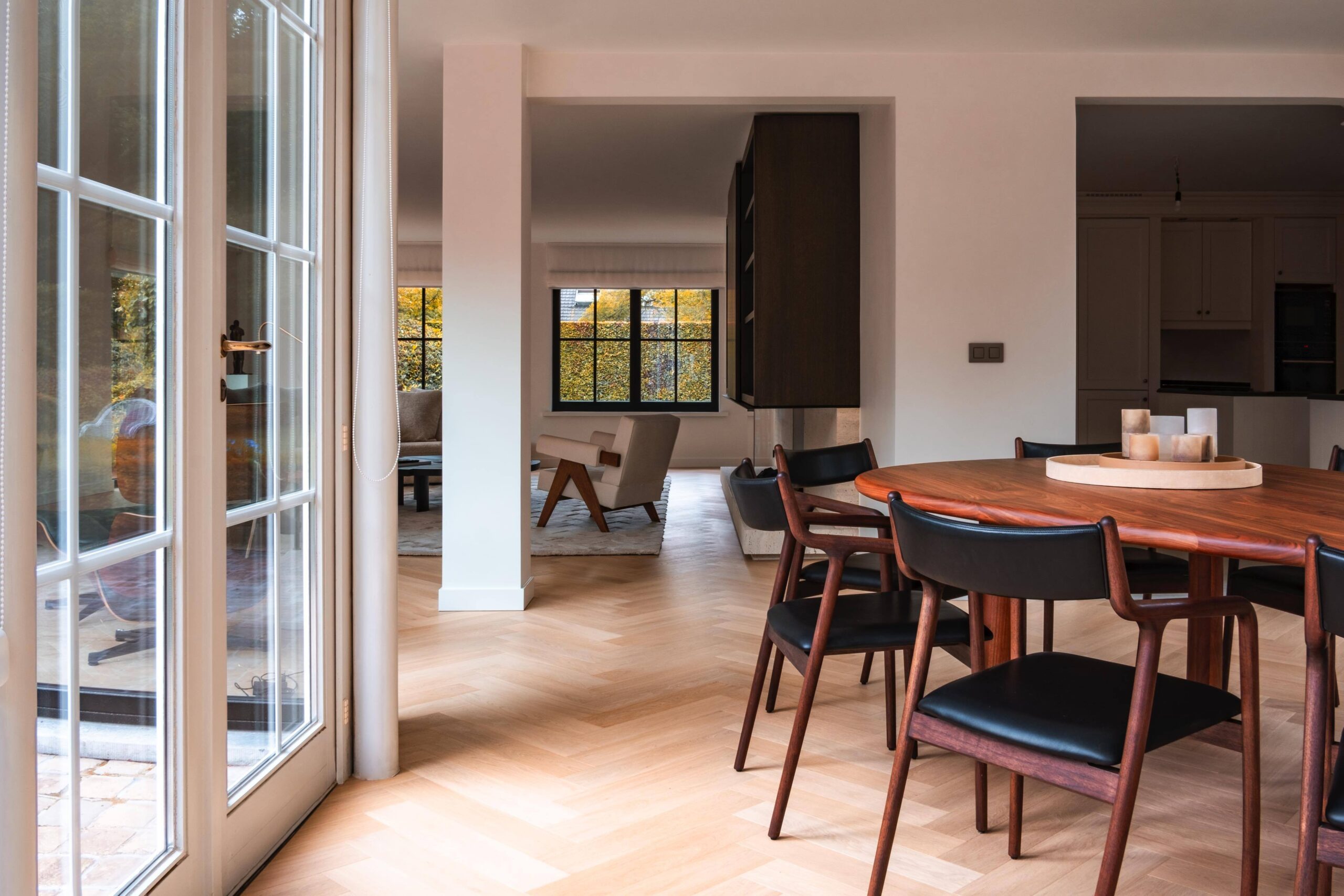
In a pattern, that behaviour is amplified. Alternate pieces sit at ninety degrees, so light strikes them differently and the floor appears to hold two tones. A pale European oak herringbone flooring reads paler than the same colour in plank, and a dark one reads darker, which is worth allowing for when the colour is chosen from a plank sample. Our European oak selection guide works through the choice.
The hardest thing to buy in wood flooring is sameness. A single apartment can absorb variation; forty apartments that have to match each other, and match the show unit that was finished a year earlier, cannot. This is the problem European oak herringbone flooring is best at solving.
The method is simple and it has to be agreed at the start. Material for the whole project is cut from one selection and stained in one batch, then held and released in phases as the building progresses. Nothing is ordered piecemeal, because a second batch is a second colour however carefully it is matched.
Where a project runs over more than one season, we keep a retained sample from the original batch as the reference for any later production. That sample, not a photograph or a colour name, is what a repeat order is matched against.
ONE SELECTION, ONE BATCH, ONE BUILDING


One selection, one stain batch, held and released as the building progresses.
Sourcing and Chain of Custody
European forestry is among the most tightly regulated in the world, and oak from certified forests carries documentation showing where it was cut and that the forest is being replanted faster than it is being harvested. For institutional clients, for hospitality groups and for any project pursuing a sustainability rating, that paperwork is part of the specification rather than a nicety.
We supply chain of custody documentation with European oak herringbone flooring on request, covering the forest of origin, the mill and the finishing plant. It is worth asking for early, because retrofitting the paperwork to material already delivered is usually impossible.
There is also a durability argument that belongs here. A floor with a four millimetre wear layer that can be refinished several times and lasts decades is a smaller environmental cost than a thinner floor replaced twice in the same period, whatever the certification on either.
Our European oak herringbone flooring is engineered rather than solid. The wear layer is solid oak at four millimetres, bonded to a cross-grain core that holds the piece flat when the humidity in a building rises and falls. In a pattern that stability matters more than it does in plank, because a short piece that cups shows as a lipped joint against its neighbours.
The construction is compatible with radiant heat, which is now standard in the residential work we supply, and it is thin enough to sit over an acoustic underlay without pushing the finished floor height past what a building specification allows.
Finishes are matt urethane or natural oil. Urethane is the practical default for rental units, hospitality and family houses. Oil suits owners who want the drier, closer feel of an unfilmed surface and accept the maintenance that goes with it.


EUROPEAN OAK HERRINGBONE
Select and light rustic
OAK FROM FORESTS REPLANTED FASTER THAN THEY ARE CUT
European Oak Herringbone Flooring Sizes
The standard size of our European oak herringbone flooring is five and a half inches wide, cut to a fixed length multiple so the pattern closes without adjustment. Larger and smaller sizes are made to order where a room needs them.
Scale is the decision people underestimate. In a small room a large pattern reads as a few big shapes rather than as a pattern at all, and in a very large room a small pattern turns into texture and loses its geometry. The size should be chosen against the floor area, not against a photograph.
Because European oak herringbone flooring shares its thickness with our plank, a patterned hall can meet a plank room at a threshold with no step and no trim, which is usually how a project moves between the two.
For a development the specification has to survive value engineering, so it needs to be written in terms that cannot be substituted quietly. Towers of the kind the Residences by Armani Casa represent are specified this way as a matter of course. Species, origin, wear layer thickness in millimetres, core construction, finish type, grade and piece size all belong in the document. A specification that says only oak herringbone will be met with something cheaper.
Programme is the other half. European oak herringbone flooring is made to order, with lead times of eight to twelve weeks, and the material has to be delivered into a closed, heated building at working humidity. Both of those need to be in the construction programme rather than discovered during fit-out.
For hospitality the wear case for European oak herringbone flooring is different again. Short pieces spread traffic across many joints instead of a few, so a patterned floor tends to hold its line better than wide plank under heavy use, and individual damaged pieces can be lifted and replaced without disturbing a whole run.
Installation Method, and Why a Pattern Cannot Float
European oak herringbone flooring has to be fully bonded to the subfloor. A floating installation, where the boards clip together and rest on a foam layer, works for plank because the floor moves as one sheet. A pattern cannot do that: the pieces run in two directions at once, so any movement pulls the geometry apart at the joints instead of taking it up at the perimeter.
Full adhesion also does the acoustic work that a floating floor gets from its underlay. A bonded floor is quieter underfoot and firmer, and in apartment buildings the acoustic requirement is met with a bonded acoustic membrane below the adhesive rather than with a loose layer.
The consequence is that the subfloor has to be right before anything arrives. Flat to a tighter tolerance than plank needs, dry, tested and recorded, and finished with any levelling compound fully cured. Most delays on a patterned floor are subfloor delays under another name.
A pattern is easier to repair than plank, and this is rarely mentioned when it is being specified. A damaged piece can be routed out and replaced individually, and because the pieces are short the repair sits within one small unit of the pattern rather than running the length of a room.
Refinishing is the other reserve. Four millimetres of solid oak carries two or three full sandings, which in practice means European oak herringbone flooring can be brought back to new twice over a life that will outlast most interior schemes. A floor with a thin veneer cannot be, which is the real difference between a wear layer and a finish.
Day to day the floor needs very little. Grit is what damages a wood floor rather than water, so matting at entrances and felt under furniture does more good than any product, and a soft brush and an occasional damp mop is the whole routine.
What the Cost Reflects
European oak herringbone flooring costs more than plank for two reasons that have nothing to do with the timber. The first is waste: the pattern meets the wall at an angle, so perimeter cutting runs around ten percent and more on a diagonal setting out. The second is labour, because every piece is set individually and the setting out has to be checked as the work proceeds.
Within the material itself, the variables that move the price are grade, colour and size. A deep custom colour costs more than a stock one because it is a separate stain batch. An oversized piece costs more because it demands wider boards to cut from.
Set against that, European oak herringbone flooring holds its appearance for decades and can be refinished rather than replaced, which is the argument for treating it as part of the building rather than part of the fit-out.
Request European Oak Samples
On a project of any size the colour has to be approved from the material rather than from a rendering, and then held so that the last apartment matches the first. We send pieces cut from current production and recorded with grade, wear layer and finish, and we retain a reference sample against which any later batch is matched. Open the Bottega collection, select the colours you want to see in herringbone, and they are sent anywhere in the United States.