
Engineered Chevron Flooring: Stability at the Mitre
Engineered chevron flooring exists because of one detail: the mitre. Every board on a chevron floor is cut back to an angle at both ends, which means the last inch of each board is a tapering wedge of timber with very little material behind it. On a solid board that wedge is the first place seasonal movement shows, and it lifts, cups or opens at the point long before anything happens in the middle of the field. An engineered board answers the problem in its construction rather than in its maintenance, and that is why almost every chevron floor we supply for occupied residences is engineered rather than solid.
The argument is not that solid timber is a lesser material. It is that a chevron floor asks timber to do something a plank floor never asks, and engineered chevron flooring is the construction that answers it.
Everything below is what we look at before recommending a construction, and it is deliberately specific. A specification that says only “engineered oak” describes almost nothing.
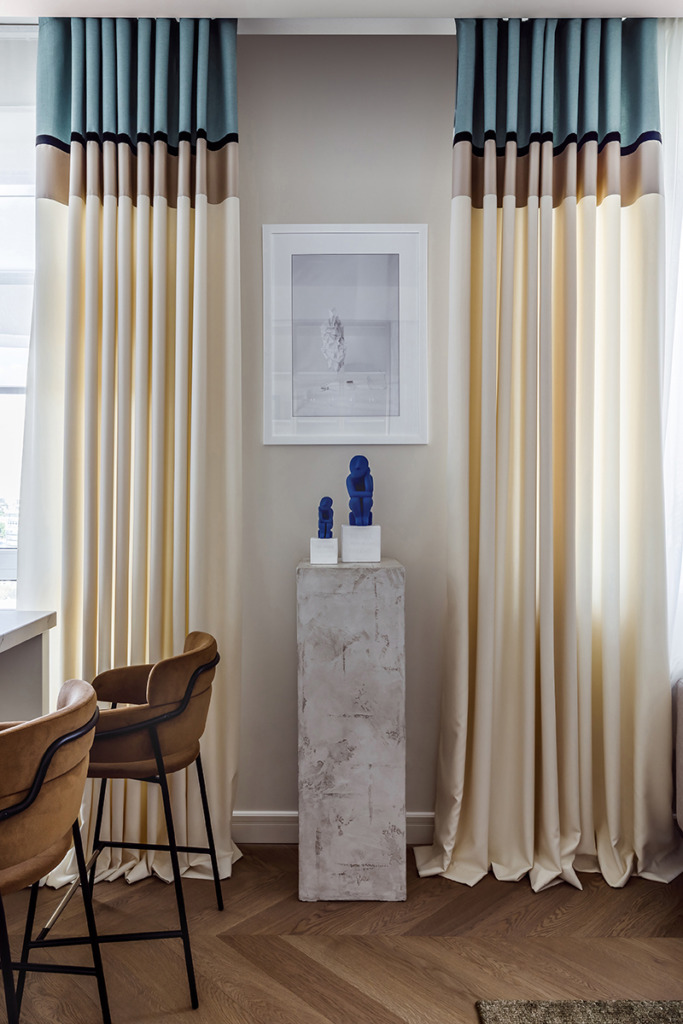
Why Engineered Chevron Flooring Behaves Differently
A solid board moves across its width with the seasons, and it moves as one piece. On a plank floor that movement is shared along a long straight joint and shows as a hairline in winter that closes again in summer. On a chevron field the same movement arrives at an angle, meets its mirror image at the point, and has nowhere to go, so it concentrates exactly where the timber is thinnest.
Engineered chevron flooring changes the direction of the problem. A multi-ply or cross-bonded core runs its layers at opposing grain directions, so the panel resists dimensional change across its width instead of expressing it. The wear layer on top is real sawn oak with the same grain, the same grade and the same finish as a solid board would carry, but it is carried by a substrate that holds the mitre flat. The visible floor is identical. What differs is what happens under it in February.
This is also why engineered construction is the norm in buildings where the floor cannot be taken up easily — high-rise apartments, landmark interiors, houses over conditioned basements — and why bonded installation and engineered board are usually specified together.
The failure mode is worth describing precisely, because it is often blamed on installation. A point that has lifted has usually not been badly bonded; it has been pushed up by the board behind it expanding along a direction the construction did not control.
Engineered chevron flooring removes that pressure at source. With the core resisting dimensional change, the board arrives at the point with almost nothing to release, and the mitre stays where it was set.
There is a second, quieter benefit. A stable board can be milled to a tighter tolerance, because the mill is not building in an allowance for movement, and tighter tolerances are what give an angled floor its crispness at the joint.
Solid chevron does still have a place. In an unheated ground floor of a historic building, over a ventilated void, with stable humidity and no underfloor heating, a solid mitred floor laid in the traditional way will last for generations. That set of conditions is rare in the buildings we are asked to supply.
Core Construction and the Wear Layer
Not all engineered board is equivalent, and on a chevron floor the differences are magnified. The core matters most. A cross-bonded birch or poplar ply core with an odd number of layers is stable in both directions and gives the mitre something rigid to sit on. A softwood block core is cheaper and moves more along its length, which is precisely the direction the point needs to be held.
Wear layer is the second decision. Four millimetres of sawn oak is the specification we work to, because it carries a full sand and refinish more than once and it puts enough material over the tip of the mitre to survive one. A thinner veneer will look identical on the day and leaves nothing at the point, which is the first place a floor is sanded through. Thicker is not automatically better either, since a very thick wear layer starts to behave like solid timber and reintroduces the movement the construction was meant to control.
Tongue and groove machining is the quiet third factor. On an angled floor the joint has to close cleanly along a cut edge as well as a milled one, and a board with tight, consistent machining assembles into a flat field where a loose one telegraphs every point.
Thickness of the finished board is the fourth decision. Fifteen to twenty-one millimetres covers most specifications, and the choice is usually made by the floor build-up rather than by performance, particularly in apartments where total height is fixed.
Where the build-up is very tight, engineered chevron flooring at fifteen millimetres over a thin acoustic layer will often solve a problem that no solid board can solve at any price, simply because the height is not available.
Backing veneer matters more than its cost suggests. A balanced construction with a backing layer of the same species and thickness as the wear layer resists cupping far better than an unbalanced one, and on an angled floor cupping shows at the point before it shows anywhere else.
We specify the full make-up on the quotation — species, wear layer, core type, number of plies, backing, total thickness — so that engineered chevron flooring from one supplier can be compared honestly with another rather than on price per square foot alone.
Sawn wear layers and sliced veneers are not the same thing. A sawn layer is cut with a blade and shows the grain as a solid board does; a sliced or peeled veneer is produced by rotating the log against a knife and reads flatter and more repetitive. On an angled floor, where grain meets grain at every point, the difference is immediately visible.
Every board we supply carries a sawn wear layer for that reason, and it is stated on the specification rather than implied.
Radiant Heat, Humidity and Seasonal Movement
Radiant heat is where engineered chevron flooring earns its specification outright. A heated floor cycles the timber daily as well as seasonally, and the mitre feels every cycle. The rules we work to are simple and non-negotiable: surface temperature capped at twenty-seven degrees, relative humidity held between forty-five and fifty-five per cent, the system commissioned and cycled before delivery, and the heating brought up gradually rather than switched on at full output after installation.
Humidity is the same discipline in a different form. A conditioned apartment in a cold climate can drop well below forty per cent in winter, and a coastal house with doors open can sit above sixty in summer. Neither is a problem for a properly built engineered board within its range, and both are a problem at the extremes for any timber floor. Where a project sits in one of those climates, humidification or dehumidification belongs in the mechanical specification rather than in a warranty exclusion.
The regional differences are set out in more detail on our chevron flooring Miami page, where movement is the governing concern, and on chevron flooring New York, where the acoustic assembly usually is.
Commissioning is the step most often skipped. A heating system that has been run up and down through its full range before the floor arrives has already driven the residual moisture out of the screed, and engineered chevron flooring laid onto a commissioned screed behaves predictably from the first winter.
Where commissioning has not happened, we will not book delivery. It is an unpopular position on a tight programme and it is the single most reliable predictor of a floor that stays flat.
Sensors are cheap. A simple temperature and humidity logger left in the room for a fortnight before delivery costs almost nothing and tells us more about how the floor will behave than any amount of discussion about specification.
Coastal and desert climates sit at opposite ends of the same problem, and both are covered on our city pages. The Miami case is set out on chevron flooring Miami, and the Californian case, where a house opens to a terrace for half the year, on chevron flooring Los Angeles.
Specifying Engineered Chevron Flooring
A specification that leaves nothing to interpretation records six things: species and grade, board width, cut angle, wear layer thickness, core construction and finish. Engineered chevron flooring is then ordered as balanced left and right hands with the quantity allowance set against the cut angle, because a steeper cut generates more perimeter waste and the allowance is not the same for every option.
Samples are supplied as a matched pair so the point can be seen closed, with the grade and the finish recorded against them. Where a project runs across several residences, we hold the grading notes and board dimensions on file so the same floor can be repeated exactly, which matters in branded developments of the kind seen at Armani Casa Residences, where consistency between units is part of the brief.
The equivalent construction question for the square-cut pattern is covered in engineered herringbone flooring, and the pattern itself is set out on our chevron flooring page.
Warranty terms follow the specification rather than the other way round. Engineered chevron flooring installed inside its stated temperature and humidity range, over a prepared substrate, with a recorded acclimatisation, is a straightforward thing to stand behind. Outside those conditions no construction performs, and no honest supplier claims otherwise.
Maintenance is the last piece. A four millimetre wear layer carries a full sand more than once, so an engineered chevron flooring specification is a long-term one rather than a disposable one, and the maintenance interval is written into the handover rather than left to be discovered.
For projects comparing constructions across patterns, the same questions applied to the square-cut floor are set out in engineered herringbone flooring, and the geometry that makes the mitre so demanding is explained in chevron flooring angles.
If you are specifying engineered chevron flooring for the first time, the shortest useful brief is this: sawn oak wear layer of four millimetres, cross-bonded ply core, balanced backing, prefinished, supplied in balanced left and right hands, with the cut angle stated. Everything else is preference.
Samples are sent as a matched pair so the point can be seen closed, and we will supply an offcut section through the board on request so the construction can be seen rather than described. Very few decisions about engineered chevron flooring survive contact with an actual cross-section, which is exactly why we offer it.
In summary, engineered chevron flooring is not a substitute for solid timber but the correct construction for a mitred floor in a conditioned building. The wear layer is real sawn oak and the visible floor is identical; what differs is what the board does in February.
Specify engineered chevron flooring with a sawn four millimetre wear layer over a cross-bonded core, balanced front and back, and the mitre will hold flat over radiant heat for the life of the floor.
Ask any supplier of engineered chevron flooring for a cross-section, the core type and the number of plies. A supplier who can answer all three without checking is usually the one to work with.
Three sentences worth remembering. Engineered chevron flooring is the construction that keeps a mitre flat. Engineered chevron flooring is only as good as its core. And no engineered chevron flooring should be bought without seeing a cross-section first.
OUR MOST DESIRED EUROPEAN OAK FLOOR
Oak Vanilla is the most specified floor in our collection, a refined European oak offered in both wide planks and herringbone. From Miami to New York, it brings a quiet authority to interiors built on restraint.
The Story Behind
Oak Vanilla is an ode to light. Its journey begins in the forests of Europe, where select oak is patiently seasoned by time. Softly bleached to reveal its quiet clarity. The wood is refined by artisans who preserve every natural rhythm of the grain. Offered in both wide planks and herringbone, its style is minimalist and enduring. From one collection to the next, this signature floor is reinterpreted through craftsmanship. It always remains true to its serene elegance.