
Chevron Flooring Angles: Cut, Pitch and Proportion
Chevron flooring angles are the first decision on a chevron floor and the one that cannot be revisited. Species, grade, tone and finish can all be adjusted while samples are moving back and forth. The angle is cut into the board at the mill, so once milling begins the proportion of the floor is fixed.
Two floors in the same oak, at the same width and in the same finish, will read as different rooms if the cut is different. The angle governs how often the eye meets a point and how far it travels between them. Chevron flooring angles are therefore a proportion decision before they are a taste decision, and they belong on the drawing beside the ceiling height and the window line rather than in a sample box.
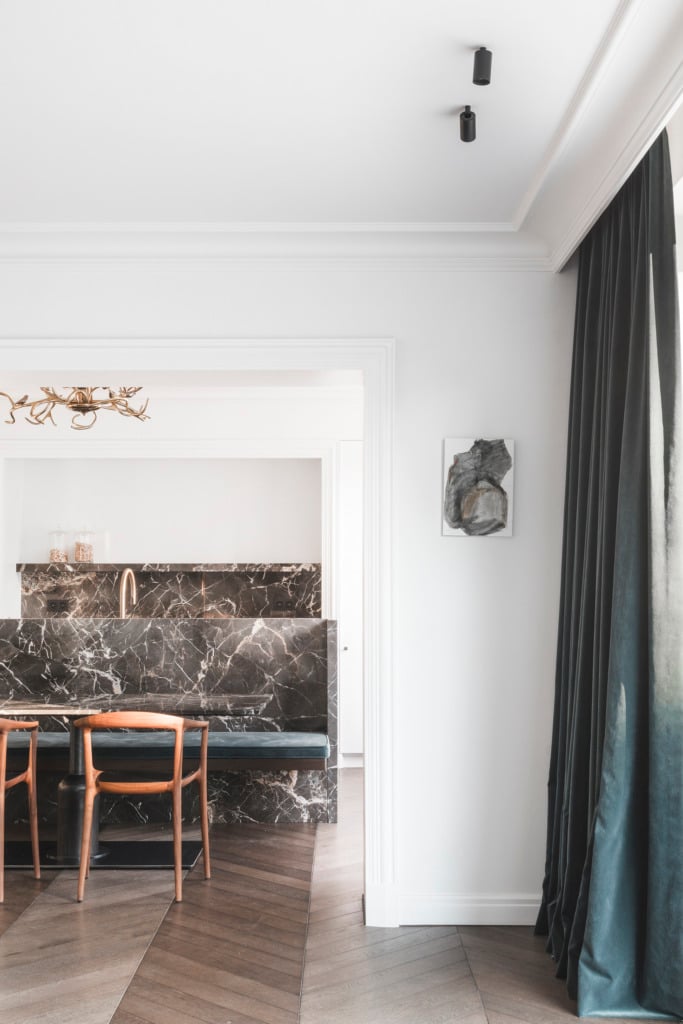
Chevron Flooring Angles and What the Cut Actually Does
A chevron board is cut to an angle at both ends, and the two boards that meet along the spine form a point. The cut angle is measured at the end of the board. The angle of the point is what you actually see.
A forty-five degree cut produces a ninety degree point, which is the classic proportion and the one most people picture when they hear the word chevron. A sixty degree cut produces a hundred and twenty degree point, which is flatter, wider and considerably longer for the same board width. Neither is more correct than the other, and both are traditional.
That difference matters because the point is the only place a chevron floor gives the eye something to stop on. A ninety degree point arrives often and the floor reads as rhythm. A hundred and twenty degree point arrives rarely and the floor reads as direction.
Chevron flooring angles are not a stylistic flourish, then, but a way of setting the tempo of a room. The choice is made against the length of the space and the distance from which the floor is normally seen, which is why we ask for a plan rather than a room size before advising on it.
There is a commercial consequence as well. A steeper cut removes more material from the end of each board and leaves more offcut at the perimeter, so the quantity allowance is not the same for both options and should be priced against the chosen angle rather than assumed from a plank calculation.
It is worth being precise about how chevron flooring angles are quoted, because the trade is not consistent. Some mills describe the cut on the board, others describe the angle of the finished point, and the two numbers are not the same. We quote the cut on the board and confirm the resulting point in writing, so nothing is left to interpretation between drawing and delivery.
A third convention appears occasionally in restoration work, where an existing floor is matched rather than specified. In that case the point is measured on site from a lifted board, and the chevron flooring angles are cut to the original rather than to a standard, which is slower but the only way a repair disappears.
Two questions settle most of it. What is the longest uninterrupted view through the space, and from what distance will the floor usually be seen? Answer those and the choice between the two standard chevron flooring angles is generally obvious within a minute.
Forty-Five Degrees, Sixty Degrees and the Room
The forty-five degree cut suits rooms that are broad rather than long, and rooms where the floor is seen from above as much as along. In a wide living space with a high ceiling, the frequent point gives the floor a texture that holds together at a distance and does not push the eye toward one wall.
It is also the more forgiving option where the plan is irregular. A shorter repeat absorbs a change of direction more easily at a threshold, and a room that is slightly out of square shows the drift less over the length of the field.
The sixty degree cut belongs in long rooms, galleries and enfilades. The elongated point stretches the pattern along the axis and the floor behaves like a drawn line, which is exactly what is wanted in a corridor or in a room that opens through a series of doorways.
It is the more demanding of the two. A long shallow V exposes any drift in the spine over distance, and it wants a plan that genuinely has a long axis rather than one invented for the sake of the floor. Where that axis exists, no other pattern uses it as well.
Light interacts with both. The two faces of the point sit at opposing angles, so they take light from different directions and the floor separates into two tones. A wider point spreads those tones into broad bands, while a tighter point breaks them into a finer weave.
Where a room takes low sun through a glass wall, that effect is strong enough that the finish is chosen to control it rather than to sit underneath it. Comparing chevron flooring angles under the actual light of the room is the only reliable way to judge this.
Ceiling height belongs in the decision as well. A tall room can carry a wide, frequent point because the floor is seen from further away and the pattern resolves into texture. A room with a standard ceiling sees the floor at a shallower angle, and a frequent point in that position reads as busy long before it reads as elegant.
Furniture is the variable everyone forgets. A large rug, a long sofa or an island will cover a substantial part of the field, and where the visible floor is reduced to margins the pattern needs a longer repeat to remain legible. We look at the furniture plan alongside the architectural one before recommending chevron flooring angles, because the floor that matters is the floor you can actually see.
Board Width, Length and the Proportion of the Point
The angle never works alone. Board width and board length set the proportion of the point as much as the cut does, and the three are specified together rather than in sequence.
A wide board at forty-five degrees gives a broad, generous V that suits a large room and looks heavy in a small one. The same width at sixty degrees becomes a long shallow band that can read as stripes rather than as a pattern if the room is not long enough to carry it.
Our chevron is milled at five and a half inches wide, which sits deliberately between the narrow European tradition and the very wide plank formats. It holds proportion in rooms of the size we are usually asked to work in, and it gives three to four full points across a normal corridor width.
Length is the quieter variable. A longer board at the same angle stretches the pattern and reduces the number of points across a floor, while a shorter board tightens it. Where a floor has to work in two adjoining rooms of different sizes, the answer is normally to hold the angle and vary nothing else, because a change of chevron flooring angles between rooms is visible at the threshold and a change of length is not.
Grade belongs in the same conversation. The point is where knots and mineral streak show most plainly, and a wider point simply shows more of the board face. The relationship between grade and character is more pronounced on an angled floor than on plank, and a grade chosen for a plank sample can look markedly busier once it is cut to a mitre.
The relationship between the angle and the room is easiest to test with a full-size dry lay. Two or three square metres set out on the floor at the proposed angle, in the actual room, settles arguments that drawings and renders never do. It costs a morning and it has changed the specification on more projects than any other single step in our process.
Where a client is choosing between two chevron flooring angles, we lay both side by side and leave them in place for a day so they can be seen in morning and evening light. The difference between them is often invisible at midday and unmistakable at five o’clock, which is exactly the point about an angled floor.
Deciding Chevron Flooring Angles at Drawing Stage
Chevron flooring angles are settled on the drawing, alongside the spine, before anything is ordered. We ask for the plan rather than the room dimensions, because the position of doorways and the sightline through the space decide the angle more reliably than length and width do.
Where a floor runs through several rooms, the angle is set to the longest continuous view rather than to the largest room. That keeps the pattern reading as one movement through the plan instead of as a series of separate decisions.
Samples are then cut as a matched pair, left and right, so the point can be seen closed and judged at the angle actually specified rather than imagined from a single board. Seeing a closed point in the room, in its own light, resolves the decision in a few minutes where photographs never do.
The buildings this pattern is specified into are drawn around axis and light — towers of the kind seen at Aman New York — and the angle of the floor is part of that drawing rather than a finish selected at the end of it.
The wider case for the pattern is set out on our chevron flooring page, the comparison with the square-cut alternative in chevron vs herringbone flooring, and the way chevron flooring angles behave in a confined space in chevron flooring in narrow rooms.
One last practical note. Chevron flooring angles cannot be changed after milling, but they can be changed after sampling, and the gap between those two moments is where the decision has to happen. We hold the specification open until the sample pair is approved and the setting-out drawing is signed, and only then release the order.
Where the same floor is specified across several residences, the angle is recorded with the grading notes so it can be repeated exactly, and the perimeter allowance is recalculated for each plan rather than carried across. Two apartments with identical floors and different room shapes will not use the same quantity, and the difference is greater on an angled floor than on plank.
Clients often ask which of the chevron flooring angles is more expensive. The board rate is the same; the difference is in the waste allowance and in the labour at the perimeter, both of which we set out on the quotation rather than folding into a square-foot figure.
If you are weighing chevron flooring angles for a specific plan, send the drawing rather than the dimensions. We will mark the spine, recommend the cut, and cut a matched sample pair to it so the decision is made from the floor itself.
To summarise what the two options give you. The forty-five degree cut is the broader, calmer of the chevron flooring angles and belongs in wide rooms seen from a distance. The sixty degree cut is the directional one, and it belongs where the plan has a genuine long axis.
Chevron flooring angles govern rhythm, and rhythm is what a room feels before it notices anything else. Board width and length adjust that rhythm; the cut sets it. Grade and finish then decide how much of the geometry the light is allowed to show.
Everything about chevron flooring angles is easier to judge in the room than on paper, which is why we cut samples as closed pairs and lay them where the floor will go. If you are choosing between chevron flooring angles for a project now, the drawing is the only thing we need to start.
OUR MOST DESIRED EUROPEAN OAK FLOOR
Oak Vanilla is the most specified floor in our collection, a refined European oak offered in both wide planks and herringbone. From Miami to New York, it brings a quiet authority to interiors built on restraint.
The Story Behind
Oak Vanilla is an ode to light. Its journey begins in the forests of Europe, where select oak is patiently seasoned by time. Softly bleached to reveal its quiet clarity. The wood is refined by artisans who preserve every natural rhythm of the grain. Offered in both wide planks and herringbone, its style is minimalist and enduring. From one collection to the next, this signature floor is reinterpreted through craftsmanship. It always remains true to its serene elegance.